Centre relaxes ban on wheat export, allows consignments registered by May 13 to go through

Centre relaxes ban on wheat export, allows consignments registered by May 13 to go through

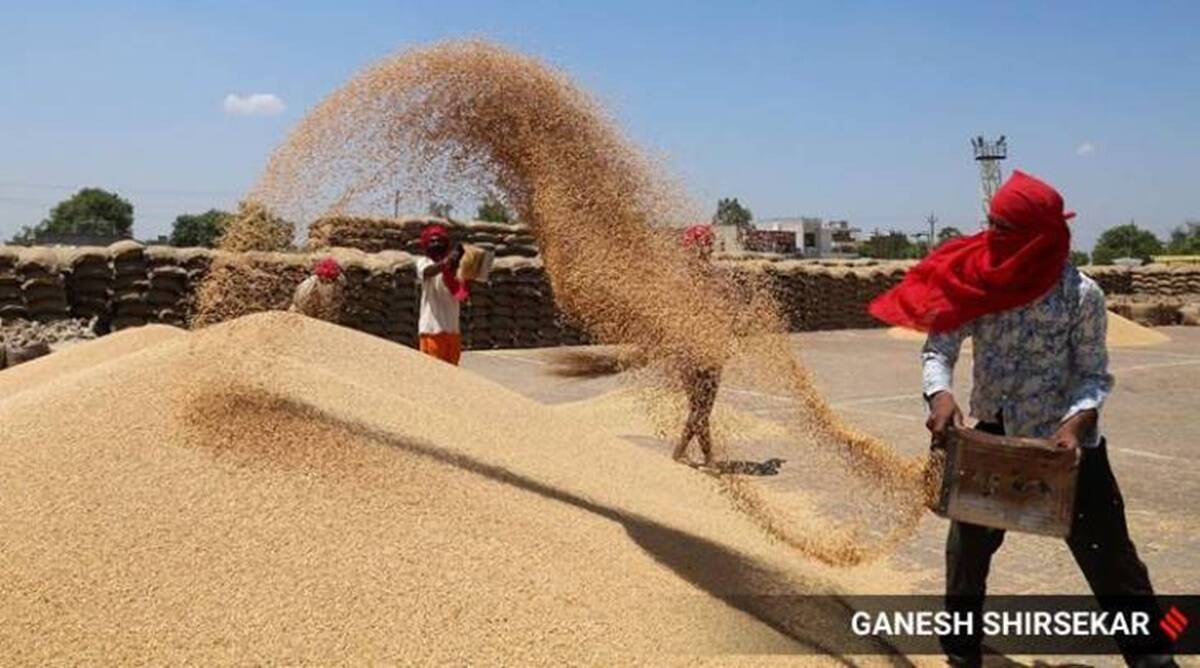
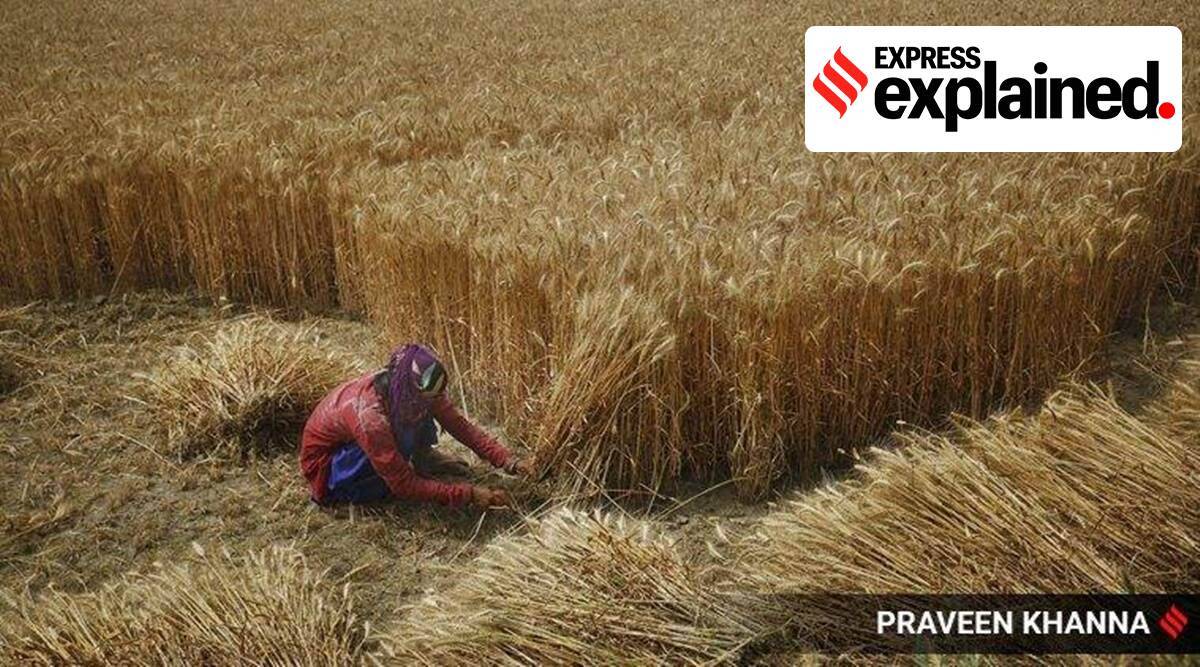
The Central Government on Tuesday announced relaxations to its order restricting wheat exports. “It’s been decided that wherever wheat consignments have been handed over to customs for examination and registered into their systems on or prior to May 13, such consignments would be allowed for export,” the Commerce Ministry’s statement read.

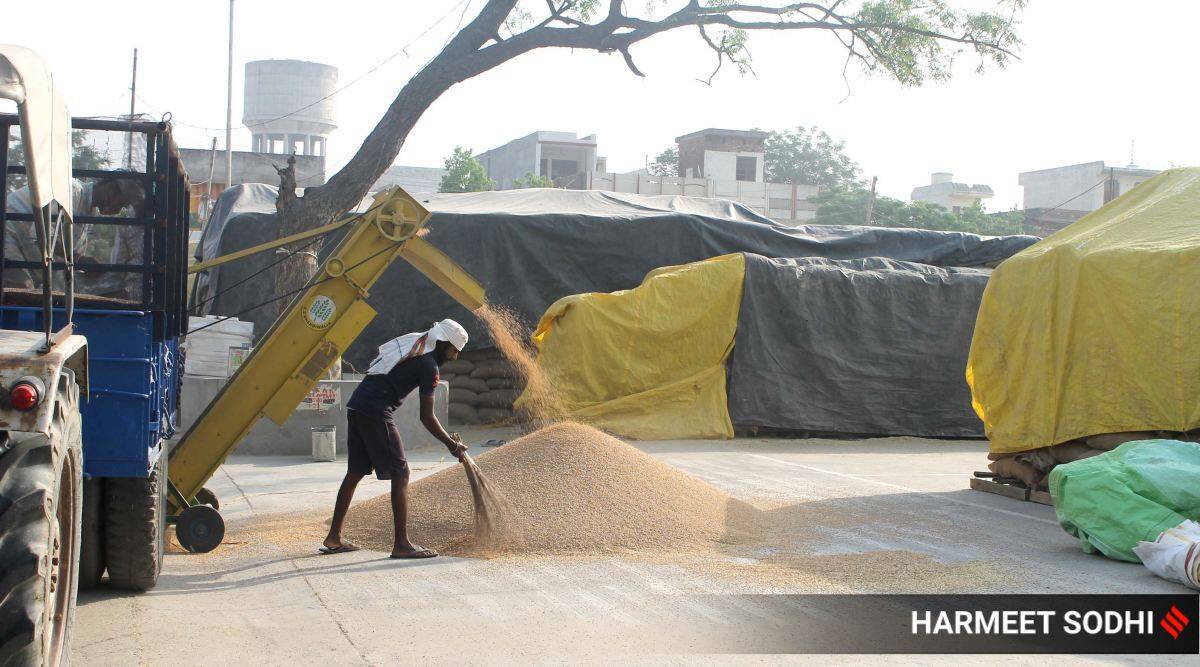
“The government also allowed a wheat consignment headed for Egypt, which was already under loading at the Kandla port. This followed a request by the Egyptian government to permit the wheat cargo being loaded at the Kandla port. M/s Mera International India Pvt. Ltd., the company engaged for export of the wheat to Egypt, had also given a representation for completion of loading of 61,500 MT of wheat of which 44,340 MT of wheat had already been loaded and only 17,160 MT was left to be loaded. The government decided to permit the full consignment of 61,500 MT and allowed it to sail from Kandla to Egypt,” the statement informed.
The Centre on Saturday had banned all shipments of wheat with immediate effect. Export of all wheat, including high-protein durum and normal soft bread varieties, were moved from “free” to the “prohibited” category.
Only two kinds of shipments were be allowed: exports based on permission granted by the Centre to other countries “to meet their food security needs” and “on the request of their governments”; and contracted exports against which irrevocable letters of credit have already been issued “on or before the date of this notification, subject to submission of documentary evidence as prescribed,” according to a notification by the Department of Commerce.
Following the ban, international prices spiked by almost 6 per cent a bushel (60 pounds or one million kernels or 27.21 kg) when global markets opened Monday. Locally, prices dropped sharply by 4-8 per cent in different states — Rs 200-250 a quintal in Rajasthan, Rs 100-150 a quintal in Punjab, and about Rs 100 a quintal in Uttar Pradesh.

!function(f,b,e,v,n,t,s)
{if(f.fbq)return;n=f.fbq=function(){n.callMethod?
n.callMethod.apply(n,arguments):n.queue.push(arguments)};
if(!f._fbq)f._fbq=n;n.push=n;n.loaded=!0;n.version=’2.0′;
n.queue=[];t=b.createElement(e);t.async=!0;
t.src=v;s=b.getElementsByTagName(e)[0];
s.parentNode.insertBefore(t,s)}(window, document,’script’,
‘https://connect.facebook.net/en_US/fbevents.js’);
fbq(‘init’, ‘444470064056909’);
fbq(‘track’, ‘PageView’);
.

India bans export of wheat with immediate effect

India bans export of wheat with immediate effect

A day after its data showed annual Consumer Price Inflation hitting a near eight-year-high of 7.79 per cent in April, and retail food inflation surging even higher to 8.38 per cent, the Narendra Modi government has banned export of all wheat from the country.
Export of all wheat, including high-protein durum and normal soft bread varieties, have been moved from “free” to the “prohibited” category with effect from May 13.
Only two kinds of shipments will be henceforth allowed. The first is “on the basis of permission granted by the Government of India to other countries to meet their food security needs and based on the request of their governments”. The second is exports under transitional arrangements, “where irrevocable letter of credit has been issued on or before the date of this notification, subject to submission of documentary evidence as prescribed,” a department of commerce notification said.
Why has wheat procurement fallen? Read our explainer to find out.

!function(f,b,e,v,n,t,s)
{if(f.fbq)return;n=f.fbq=function(){n.callMethod?
n.callMethod.apply(n,arguments):n.queue.push(arguments)};
if(!f._fbq)f._fbq=n;n.push=n;n.loaded=!0;n.version=’2.0′;
n.queue=[];t=b.createElement(e);t.async=!0;
t.src=v;s=b.getElementsByTagName(e)[0];
s.parentNode.insertBefore(t,s)}(window, document,’script’,
‘https://connect.facebook.net/en_US/fbevents.js’);
fbq(‘init’, ‘444470064056909’);
fbq(‘track’, ‘PageView’);
.

Explained: Behind low wheat procurement

Explained: Behind low wheat procurement

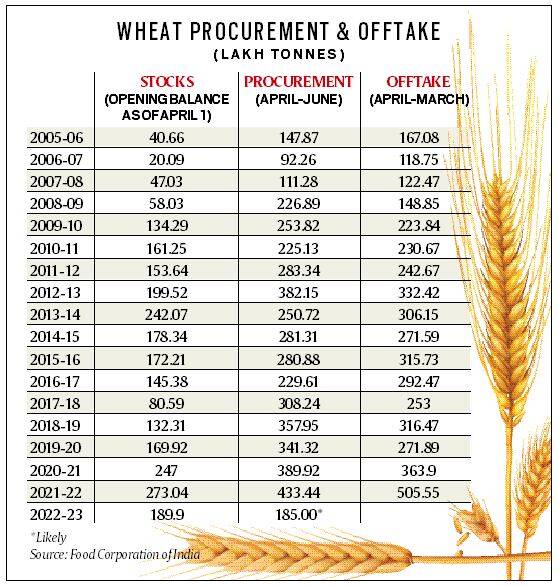
Wheat procurement by government agencies is set to dip to a 15-year low in the current marketing season, from an all-time high scaled last year.
The 18.5 million tonnes (mt) likely procurement this time — farmers mostly sell from April to mid-May, although government wheat purchases technically extends until June and the marketing season until the following March — will be the lowest since the 11.1 mt bought in 2007-08.

Moreover, this would be the first time that wheat procured from the new crop (18.5 mt) is less than the public stocks at the start of the marketing season (19 mt). As the table shows, fresh procurement has always exceeded the opening balance stocks. It was so even during the previous two low procurement years of 2006-07 and 2007-08.
This year would be an exception and in sharp contrast to 2020-21, which had unprecedented levels of both opening stocks (27.3 mt) and procurement (43.3 mt).

Why it has fallen
There are two main reasons for procurement plunging to a 15-year-low this time.
The first is export demand.
In 2021-22, India exported a record 7.8 mt of wheat. Supply disruptions from the Russia-Ukraine war – the two countries account for over 28% of global wheat exports – have led to skyrocketing prices and a further increase in demand for Indian grain. On Friday, wheat futures prices at the Chicago Board of Trade exchange closed at $407.30 per tonne, as against $276.77 a year ago. With Indian wheat getting exported at about $350 or Rs 27,000 per tonne free-on-board (i.e. at the point of shipping), farmers are realising well above the minimum support price (MSP) of Rs 20,150/tonne at which government is procuring. This is even after deducting various costs – from bagging and loading at the purchase point, to transport and handling at the port. These would add up to Rs 4,500-6,000 per tonne, depending on the distance from the wholesale mandi to the port.

The second reason is lower production.
In mid-February, the Union Agriculture Ministry estimated the size of India’s 2021-22 crop (marketed during 2022-23) at 111.32 mt, surpassing even the previous year’s high of 109.59 mt. But the sudden spike in temperatures from the second half of March — when the crop was in grain-filling stage, with the kernels still accumulating starch, protein and other dry matter — has taken a toll on yields. In most wheat-growing areas — barring Madhya Pradesh, where the crop is harvest-ready by mid-March — farmers have reported a 15-20% decline in per-acre yields.

A smaller crop, in combination with export demand, has resulted in open market prices of wheat crossing the MSP in many parts of India. The shorter the distance to the ports, the higher the premium that exporter/traders have paid over the MSP. Even in Punjab and Haryana — where the state governments charge up to 6% market levies, compared to 0.5-1.6% in MP, Uttar Pradesh and Rajasthan — flour millers have paid farmers Rs 50-100 above the MSP of Rs 20,150 per tonne. Traders and millers aren’t the only ones stocking up in anticipation of prices going up further. Many farmers, especially the more entrepreneurial/better-off sections among them, are also holding back their crop. Such “hoarding” by farmers was seen in the recent past in soyabean and cotton, too, again driven by soaring international prices.
Newsletter | Click to get the day’s best explainers in your inbox
The end-result of a heatwave-affected crop and open market prices rising closer to export parity levels has been that procurement by government agencies has plummeted to 9.6 mt in Punjab (from 13.2 mt last year), and even more in MP (12.8 mt to 4 mt), Haryana (8.5 mt to 4.1 mt) and other states (8.8 mt to not more than 0.8 mt).
Impact on availability
With opening stocks of 19 mt and expected procurement of 18.5 mt, government agencies would have 37.5 mt of wheat available for 2022-23. Not all this, however, can be sold, as a minimum operational stock-cum-strategic reserve has to be maintained. The normative buffer or closing stock requirement for March 31 is 7.5 mt. Providing for that will leave 30 mt available for sale from government godowns this fiscal.
That quantity should suffice for the public distribution system, midday meals and other regular welfare schemes, whose annual wheat requirement is around 26 mt. But the last two years have also witnessed substantial offtake under the Pradhan Mantri Garib Kalyan Anna Yojana scheme (10.3 mt in 2020-21 and 19.9 mt in 2021-22) and open market sales to flour mills (2.5 mt and 7.1 mt, respectively). There’s clearly not enough wheat for these, which explains the Centre’s recent decision to slash allocation under the PMGKAY from 10.9 mt to 5.4 mt for April-September 2022. Meeting even this requirement may not be easy, leave alone supplying to millers and other bulk consumers to moderate open market prices during the lean months after October.
Simply put, one can expect wheat prices to firm up and a rerun of what happened in 2006-07 and 2007-08. That period, too, saw a worldwide agri-commodity price boom and production shortfalls, causing reduced procurement and depletion of stocks.
However, the relatively tight supplies in wheat this time is compensated for by the comfortable public stocks of rice. At over 55 mt as on April 1, these were more than four times the required buffer of 13.6 mt. And a good monsoon should further augment availability from the ensuing kharif crop and tide over the shortages in wheat.

!function(f,b,e,v,n,t,s)
{if(f.fbq)return;n=f.fbq=function(){n.callMethod?
n.callMethod.apply(n,arguments):n.queue.push(arguments)};
if(!f._fbq)f._fbq=n;n.push=n;n.loaded=!0;n.version=’2.0′;
n.queue=[];t=b.createElement(e);t.async=!0;
t.src=v;s=b.getElementsByTagName(e)[0];
s.parentNode.insertBefore(t,s)}(window, document,’script’,
‘https://connect.facebook.net/en_US/fbevents.js’);
fbq(‘init’, ‘444470064056909’);
fbq(‘track’, ‘PageView’);
.

Free-from meets premium | Food Business News

Free-from meets premium | Food Business News

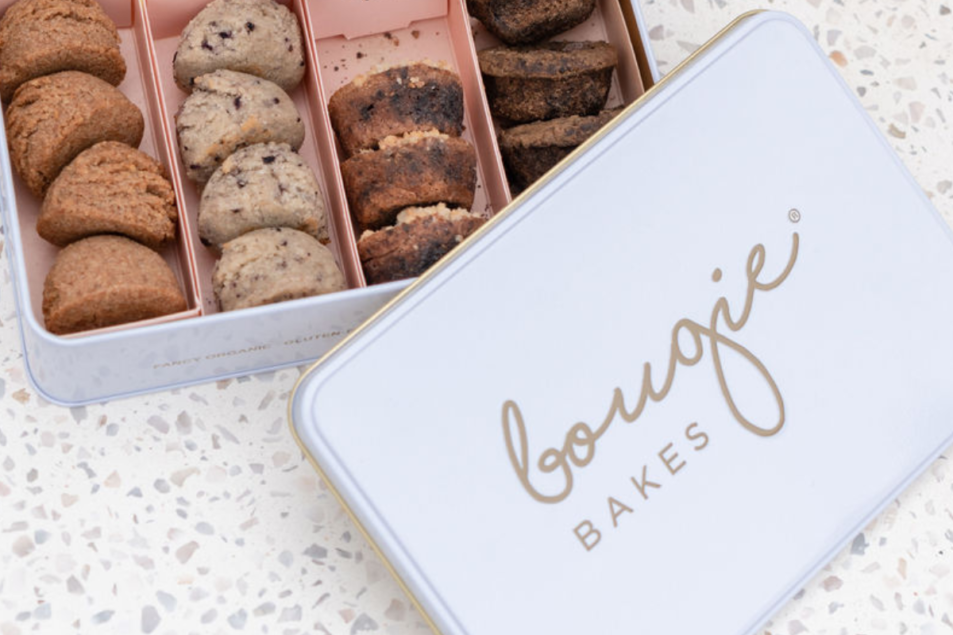
LOS ANGELES — Bougie Bakes, a direct-to-consumer bakery based in Los Angeles, produces and markets an assortment of sugar-free, dairy-free, gluten-free cookies, brownies and muffins. Married co-founders Ryan and Meghan Quinn named the business as a nod to the premium ingredients used — “if our recipe calls for a dash of salt, we make sure it’s pink Himalayan; if we need to use eggs, they’re pasture-raised.”The pair, who met during earlier careers in media advertising sales, launched the venture shortly after their wedding three years ago. In the months prior, the couple committed to following a nutrition plan that excluded gluten and limited sugar and dairy, but they struggled to resist late-night cravings for ice cream and cookies.“I just felt like we were working so hard through the day, eating right, working out, and then at night we would sabotage all of that hard work,” Ms. Quinn recalled. “So, we started making baked goods at home following simple recipes with ingredients we knew we could have and that complied with our diet.”As the newlyweds began sharing batches of the baked treats with friends and family and scouring the marketplace for similar products, a business opportunity emerged.“We looked at categories that were growing, and we looked at ingredient profiles we were currently using but could tweak a little bit,” Mr. Quinn said. “We switched from using ghee to coconut oil because we realized if we had a gluten-free, sugar-free, dairy-free product, we would come to the market with a completely unique product from an ingredient profile perspective.”Additional ingredients in the formulations include almond flour, erythritol, plant-based collagen and unsweetened vanilla macadamia milk. The products are baked to order and contain no preservatives. Offerings range from pumpkin pecan blondie bites and peppermint brownie bites to rainbow sprinkle cookies to vegan orange cranberry muffins.“We release a limited-edition seasonal product every two to three months,” Mr. Quinn said. “Two of those flavors have come from consumer surveys. Raspberry lemon was a cookie we did last year, which was one of our most popular seasonal launches ever and a flavor we would not have thought of or combined, but it was randomly the top write-in customer request.”Another point of differentiation is presentation. Initial orders are shipped in branded reusable tins. Reorders are minimally wrapped and placed in recyclable trays.“We really wanted to create something that was giftable and a premium unboxing experience for people purchasing these as treats for themselves,” Ms. Quinn said. “A lot of the feedback we got in the beginning when we were doing initial surveys of people with dietary restrictions was they always felt like their various restrictions kept them from indulging or made them feel weird at social gatherings, so we wanted to flip that on its head and make people with dietary restrictions feel really special and unique.”Recently, the company added Bougie Barks, a line of dog treats formulated with almond flour, peanut butter, carob powder, collagen powder and ground flaxseed.“Those came about because we got a puppy, and we didn’t like the treats we were feeding her, so we decided to make our own,” Mr. Quinn said. “That opens up a whole other market opportunity for us within the pet space.”On the heels of an “explosive year of growth,” the founders are focused on expanding the team and scaling operations with plans to offer a limited selection of items in retail stores next year.“We started out in the home kitchen, Meg doing the baking, me doing the packing as I’m on sales calls,” Mr. Quinn said. “Once we grew out of that, we moved into a commercial space, got a team, had some help baking and packing.“Once that scaled up, we moved to a bigger space, and we got bigger equipment and some packaging machines. Everything we bake is handmade. We actually just celebrated our 2 million bakes sold, and we were looking back on that, saying, ‘Wow, I can’t believe all 2 million plus of these bakes were hand scooped or hand cut.’” .