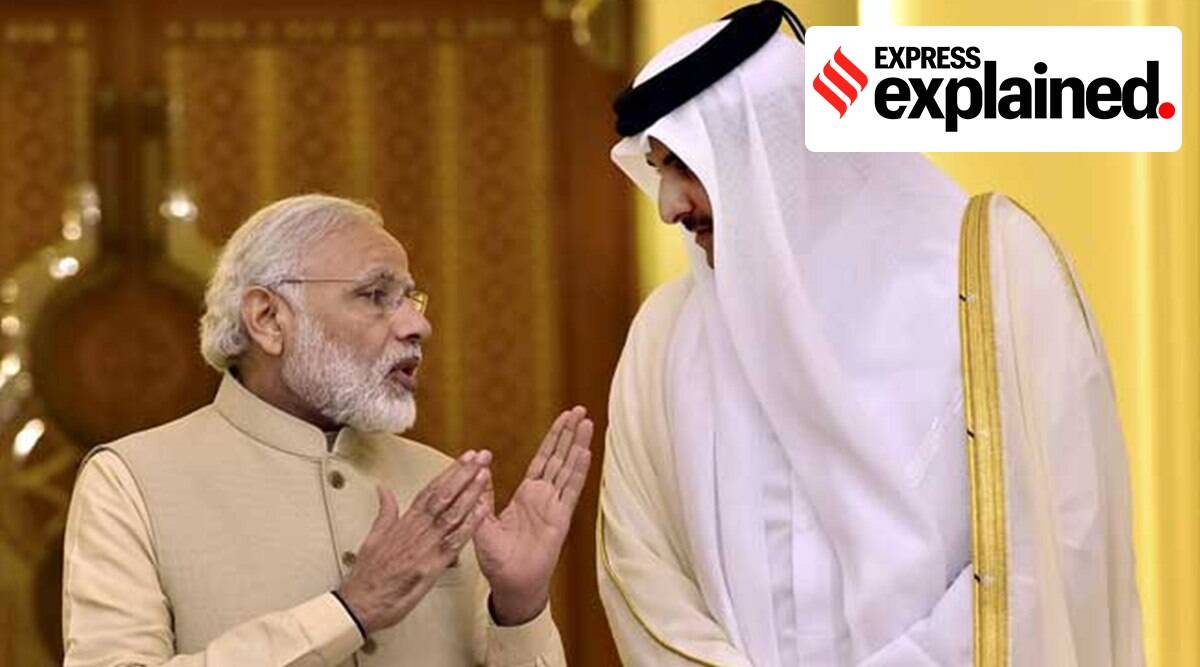
At a time India is carefully navigating the post-February 24 geopolitical flux, calibrating its stand on both sides of the divide over Ukraine, the derogatory references to Islam by spokespersons of the ruling BJP have put the country on the defensive on the global stage.
Qatar, Kuwait and Iran were the first to speak out Sunday, followed by Pakistan, Saudi Arabia and Oman, the Gulf Co-operation Council and the Organisation of Islamic Co-operation. On Monday, special friend UAE in the Gulf, Bahrain and Indonesia in south-east Asia, also joined the increasing chorus of protests.
In the Gulf region that Prime Minister Narendra Modi takes personal credit for having turned around for India, Delhi has been in fire-fighting mode the last 48 hours. The silence of Turkey and Malaysia is some consolation but it is not clear how long that will hold. Al Azhar, the influential Islamic university in Cairo, denounced the statements as “terrorist action that helps to push the entire world to devastating crises and bloody wars”.
Indian envoys in the region find themselves battling an “image problem”, and trying to ensure that what was spoken on TV back home does not have an adverse fallout on the significant Indian diaspora in these countries: an estimated 6.5 million Indians who live and work in the region.Best of Express Premium Premium
 Premium
 Premium
 Premium
This is not the first time that anti-Muslim actions by Indians have resonated in West Asia.
In 2020, after the government singled out the Tableeghi Jamaat congregation in Delhi as a Covid super-spreader, leading to a spike in anti-Muslim conduct in India, Sheikha Hend bint Faisal Al Qasimi, an Emirati businesswoman described as a ruling family royal, in a tweet that tagged anti-Tableeghi tweets by an Indian living in Dubai, said: “Anyone that is openly racist and discriminatory in the UAE will be fined and made to leave”. In 2018, a Michelin-starred chef was fired for posting an anti-Islam tweet.
Recently, the film Kashmir Files was banned in the UAE briefly before being given permission for screening. Last week, Oman and Kuwait banned the new Akshay Kumar film Privthviraj.
🚨 Limited Time Offer | Express Premium with ad-lite for just Rs 2/ day 👉🏽 Click here to subscribe 🚨
The Modi government’s deference to the sensitivities of Islamic West Asia — the BJP suspended the two spokespersons – is in contrast to its curt dismissal of US concern about India’s minorities. Ironically, the relationship that Delhi has crafted in the Gulf before and after 2014 had little to do with religion. The current controversy has put that under a cloud.
“In the past, incidents of communal hate and violence were seen as part of India’s domestic politics. But when you make derogatory references to the Prophet and bring in his wife, you have crossed a red line,” said Talmiz Ahmad, who served as India’s ambassador to Saudi Arabia, UAE and Oman between 2000 and 2011.
“Earlier, when an incident such as the Babri Masjid demolition took place, there was faith that India remained committed to a democratic and plural order, but now there is a feeling that this aspect of India’s commitment has changed.”
In New Delhi, it is hoped that despite the outrage, the core of India’s bilateral relationships with each of these countries will remain unaffected, based as these relations are on the Indian economy, trade and investment, the sale of oil to India, and the huge Indian workforce, in which their religious affiliation has never played a big part.
India and UAE describe their relationship as a strategic partnership. A significant security component is now a part of India’s relationship with several Gulf countries, especially after ISIS burst on the scene in the region.
With ISIS cells in the Gulf, intelligence co-operation with Saudi Arabia and the UAE is reported to have led to the deportation from these countries of dozens of individuals of interest between 2014 and 2017. India and Gulf countries such as UAE, Saudi and Oman carry out joint military exercises.
In March, India and the UAE also signed a Comprehensive Economic Partnership Agreement, seen as a launching pad for a free trade agreement with GCC countries. That’s why the “boycottIndiangoods” hashtag that was trending on Sunday sent a wave of apprehension among those with stakes in businesses in the Gulf.
One immediate implication could be for employment, said Ahmad. “India was seen as a role model of a democratic, pluralistic and accommodative nation that had also achieved considerable progress and technological achievement. That has been affected badly,” he said.
In the foreign policy establishment, there is also concern that this could paper over the deep rifts between Pakistan, and its old allies Saudi and UAE given that Islamabad resented the growing proximity between these countries and New Delhi.
!function(f,b,e,v,n,t,s)
{if(f.fbq)return;n=f.fbq=function(){n.callMethod?
n.callMethod.apply(n,arguments):n.queue.push(arguments)};
if(!f._fbq)f._fbq=n;n.push=n;n.loaded=!0;n.version=’2.0′;
n.queue=[];t=b.createElement(e);t.async=!0;
t.src=v;s=b.getElementsByTagName(e)[0];
s.parentNode.insertBefore(t,s)}(window, document,’script’,
‘https://connect.facebook.net/en_US/fbevents.js’);
fbq(‘init’, ‘444470064056909’);
fbq(‘track’, ‘PageView’);
.