Cloud over output from UP, Govt likely to restrict sugar exports

Cloud over output from UP, Govt likely to restrict sugar exports

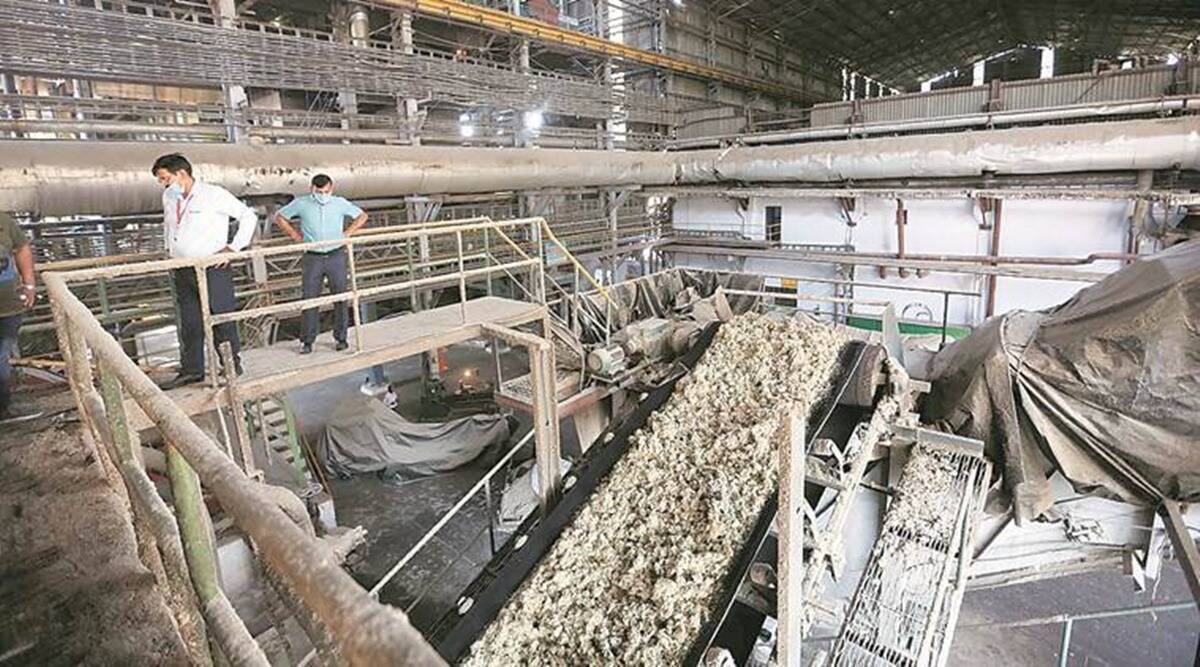
After banning exports of wheat and broken rice, the Narendra Modi government is set to take a call next on sugar.
Mills, in all likelihood, will be allowed to export up to 50 lakh tonnes (lt) of the sweetener in the new sugar year from October. Any decision on further quantities would be taken in January-February after a review of domestic production and price trends.
On May 24, the Modi government had moved sugar exports from the “free” to “restricted” category. It also capped total exports for the 2021-22 sugar year at 100 lt, which was raised to 112 lt with effect from August 1.

“They (government) are concerned about output, particularly in Uttar Pradesh where the monsoon rainfall has been nearly 43 per cent deficient and there are also reports of the cane crop being affected by red rot (a fungal disease),” a source told The Indian Express.
The current 2021-22 sugar year has seen both production and exports from India touch record levels of 360 lt and 112 lt respectively. However, closing stocks, estimated at 60 lt on September 30, would be a five-year low.
“That’s still equivalent to two-and-a-half months’ consumption (projected at 275 lt for the whole year). Also, lower production in UP is likely to be offset by increases in Maharashtra, Karnataka and Tamil Nadu, where rains have been good and reservoirs are full. But they don’t want to take any chances, especially after the latest consumer food price inflation number of 7.62 per cent for August,” the source said.

Prakash Naiknavare, managing director of the National Federation of Cooperative Sugar Factories, said that permitting exports in tranches makes sense, as it will enable mills to enter into contracts before they start production for the new year (crushing operations usually take off post-Diwali).
“The government has already sounded us out that mills can sign export contracts up to 15 per cent of their production (projected at 330-360 lt in 2022-23). We have conveyed this to our members so that they can plan accordingly,” he added.

A strategy to regulate exports after reviewing the domestic availability position is likely in 2022-23 as well.
“The notification allowing an initial quantity of 50 lt is expected in the next few days. A second tranche of 30-35 lt may follow by February, when a reasonable estimate of production can also be made,” the source said.

ExplainedAfter rice and wheatRice, wheat and sugar were three “surplus” agro-commodities. But a whittling down of the surpluses has reignited inflation concerns — and prompted the government to impose restrictions.

Mills are keen to start exports early for two reasons. The first is that the world’s biggest exporter Brazil’s sugar season is from April to November. It gives a window of exports for Indian mills, which crush from late-October to early-May.
The second is prices. White sugar for December delivery is currently quoting at about $538 per tonne. Indian sugar, being less white/refined, would fetch a $50 quality discount or $488 (Rs 39,000) per tonne.
Deducting Rs 3,500 costs (towards bagging, transport from factory to port, stevedoring, and handling) translates into an ex-mill price of Rs 35,500 per tonne. That’s more than the roughly Rs 34,000 that Maharashtra mills are realising from domestic sale of ‘S-grade’ (small-sized granules) sugar.
Indian mills have also been exporting raw sugar, which fetches a 4 per cent “polarisation” premium (for being more amenable to refining into whites) in the world market.

December raw sugar prices are now 17.97 cents per pound, corresponding into 18.69 cents or $412 (Rs 33,000) per tonne from. The expenses are also about Rs 500 per tonne lower, since raw sugar is shipped out in bulk break vessels, as against containers in the case of whites.
India’s sugar exports, which were a mere 0.46 lt in 2016-17 and 6.32 lt in 2017-18, soared to 38 lt, 59.40 lt and 71.90 lt in the subsequent three sugar years, before the all-time-high of 112 lt achieved in 2021-22.
Drought in Brazil in 2021 and in Thailand the year before – and this year’s heat wave in the European Union – have created export opportunities for Indian mills. But whether they can fully seize it now, given inflation worries back home, remains to be seen.
The Modi government, on May 13, banned wheat exports. On September 8, it prohibited exports of broken rice, besides slapping a 20 per cent duty on shipments of other non-parboiled non-basmati varieties.

!function(f,b,e,v,n,t,s)
{if(f.fbq)return;n=f.fbq=function(){n.callMethod?
n.callMethod.apply(n,arguments):n.queue.push(arguments)};
if(!f._fbq)f._fbq=n;n.push=n;n.loaded=!0;n.version=’2.0′;
n.queue=[];t=b.createElement(e);t.async=!0;
t.src=v;s=b.getElementsByTagName(e)[0];
s.parentNode.insertBefore(t,s)}(window, document,’script’,
‘https://connect.facebook.net/en_US/fbevents.js’);
fbq(‘init’, ‘444470064056909’);
fbq(‘track’, ‘PageView’);
.
MSP boost could bolster govt’s cereal stocks. But it must keep sight of crop diversification, the long-term reform measure

MSP boost could bolster govt’s cereal stocks. But it must keep sight of crop diversification, the long-term reform measure

The Narendra Modi government has hiked the minimum support price (MSP) for this year’s paddy crop by Rs 100 per quintal over 2021-22. It is higher than the Rs 72, Rs 53 and Rs 65 per quintal increase during the preceding three years, while below the Rs 180-200 of 2018-19, which was in the run up to the 2019 general election. This time’s MSP raise has less to do with politics. The Commission for Agricultural Costs & Prices (CACP) has estimated the average production cost of paddy (all paid-up expenses plus an imputed value of unpaid family labour) for 2022-23 at Rs 1,360 per quintal. The MSP of Rs 2,040 per quintal for common paddy, then, translates into a 50 per cent return over cost. Last year’s MSP of Rs 1,940 also delivered the same return over a projected cost of Rs 1,293 per quintal. Farmers, thus, are only being compensated for higher cultivation costs.
Production cost going up — probably more than the CACP’s 5.2 per cent estimate — is not the sole reason for the Modi government granting an above-trend MSP hike in paddy. A more pertinent factor has to do with public foodgrain stocks, which, at 311.42 lakh tonnes (lt) for wheat as on June 1, are the lowest in 14 years for this date. Although rice stocks, at 496.76 lt, are above last year’s corresponding level of 491.50 lt, the government clearly isn’t taking any chances. With the next wheat crop arriving only in April 2023, there will be that much added dependence on rice now to meet the requirements of the public distribution system. Hence, the need to ensure adequate stocks and procurement of paddy, whose plantings take off in June and marketing from October. Barely three months ago, the country had enough grain for free distribution through ration shops and also for exports. The post-March heat wave that took a toll on wheat crop yields and more than halved government procurement has made things a tad precarious.
There is a perverse side to the short-term imperative to bolster government cereal stocks. It undermines the cause of crop diversification. Weaning farmers — especially in states such as Punjab, Haryana, Telangana and Maharashtra — away from water-guzzling paddy and sugarcane to growing oilseeds, pulses, cotton, fruits, vegetables and other high-value crops is what is necessary from a long-term nutritional as well as agro-ecological perspective. The current system of assured MSP and open-ended procurement for only paddy, wheat and sugarcane cultivated in a handful of states is simply unsustainable, both fiscally and environmentally. Depleted public stocks and high global prices of cereals are a temporary phenomenon. The Modi government should not take its eye off the real reform road ahead.
This editorial first appeared in the print edition on June 10, 2022 under the title ‘MSP and more’.Best of Express PremiumAn 8-km elevated road, 3 ‘finger bridges’ to ghats: UP govt comes up with...PremiumRajiv Mehrishi: Finance secretary, home secretary, CAG — and now pickle-m...PremiumDelhi Confidential: Helping OutPremiumExplained: Why bond yields are rising, and what it means for markets and ...Premium

!function(f,b,e,v,n,t,s)
{if(f.fbq)return;n=f.fbq=function(){n.callMethod?
n.callMethod.apply(n,arguments):n.queue.push(arguments)};
if(!f._fbq)f._fbq=n;n.push=n;n.loaded=!0;n.version=’2.0′;
n.queue=[];t=b.createElement(e);t.async=!0;
t.src=v;s=b.getElementsByTagName(e)[0];
s.parentNode.insertBefore(t,s)}(window, document,’script’,
‘https://connect.facebook.net/en_US/fbevents.js’);
fbq(‘init’, ‘444470064056909’);
fbq(‘track’, ‘PageView’);
.

Eight years on | The Indian Express

Eight years on | The Indian Express

THE Narendra Modi government completing eight years is a moment to pause and look back — and ahead. When it came to power in 2014, a large swathe of Indian voters saw in the slogan of “achche din”, and in the BJP’s energetic bid to wrest power at the Centre under the leadership of a man who had made himself a name, and controversy, as chief minister, a promise for a break from the status quo. In the first five years, from rethinking the language of welfare to recasting nationalism and reworking foreign policy, the Modi government made an impact that led to its re-election in 2019 with a decisive majority. Looking back, the eight years of Modi’s rule so far have been dominated by the last three. And in these, the government’s record has been two-toned — it has shown resolve, boldness, and a capacity for navigating complexity in some areas but it has been stiff and unmoving in others.
The signal that the second term would be more change-making than the first was sent by the abrogation of Article 370 in Kashmir in August 2019. Only months after that, came the enactment of a law that made religion a criterion for citizenship for those in the neighbourhood seeking refuge. The next year, the government inaugurated the construction of the Ram temple at Ayodhya. But if the Modi government took these large, contentious steps, it also faced steep challenges. While the over a year-long farmers’ agitation on Delhi’s doorstep could be traced back to the farm laws it enacted in September 2020, the public health emergency that began with the Covid outbreak earlier that year, and this year’s Ukraine war, are problems it has been forced to step up to. On balance, the Modi government has shown a mature head in crisis, coming back after a period of paralysis during Covid’s second devastating wave, to set in motion a strikingly successful vaccination programme. It resisted pressures to provide more direct support to a people lacking in safety nets, but ran a comprehensive free rations programme, ensuring efficient and mostly corruption-free delivery. Amid the continuing economic slump and joblessness, it has signalled a recommitment to its privatisation programme, with the sale of Air India and the LIC IPO. With China, after the face-off in Galwan, and 15 rounds of talks later, it shows firmness and resolve. With the US, it is strategically — and boldly — strengthening areas of convergence in the Indo-Pacific, even as, on Ukraine, it has negotiated a position keenly conscious of competing priorities. All this, under the leadership of a prime minister whose popularity is burnished more strongly than before.
And yet, the maturity and nuance that the Modi government shows in the areas outlined above seem to elude it when it comes to others — be it its heavy-footed handling of the agitation against the CAA-NRC, its attempt to forcibly join the dots between those protests and the communal violence later in northeast Delhi, its use of the IPC to tar dissent, its weaponisation of Central agencies to target political opponents. Its ringing silence amid the bid to reopen the faultline that now stretches from Ayodhya to Gyanvapi and its failures to restore the political process in Kashmir are part of the same problem. A government capable of thinking afresh seems trapped in stale resentments when it comes to the imperative that lies at the heart of democracy: Trust between communities and a respectful place for minorities. With the Opposition weaker than it was, and not many countervailing institutions, the Modi government will need to find it in itself to course correct. For, the challenges of inflation and recession, Ukraine war, China’s sabre-rattling, expectations of the young — these call for a governance that includes all, that does not let ghosts of history hijack spirits of the future, that heals old wounds without rubbing them in. Eight years on, that’s the hope.
Best of Express PremiumThe ballad of Sidhu Moose Wala: Self-made, temperamental, the man from MoosaPremiumBlow to VIP culture, or political vendetta? Punjab govt orders stir up rowPremiumWhy I fell in love with Microsoft’s Surface Laptop Studio despite its sho...PremiumPenalties for delays, cuts in weekly pay: Life gets riskier for 10-minute...Premium
!function(f,b,e,v,n,t,s)
{if(f.fbq)return;n=f.fbq=function(){n.callMethod?
n.callMethod.apply(n,arguments):n.queue.push(arguments)};
if(!f._fbq)f._fbq=n;n.push=n;n.loaded=!0;n.version=’2.0′;
n.queue=[];t=b.createElement(e);t.async=!0;
t.src=v;s=b.getElementsByTagName(e)[0];
s.parentNode.insertBefore(t,s)}(window, document,’script’,
‘https://connect.facebook.net/en_US/fbevents.js’);
fbq(‘init’, ‘444470064056909’);
fbq(‘track’, ‘PageView’);
.
Be clear on cotton | The Indian Express

Be clear on cotton | The Indian Express

After wheat, there is pressure building up for banning exports of raw cotton. The Narendra Modi government must resist any such demand emanating from domestic textile mills and the garment industry. There are at least three reasons why this is so. To start with, the output of one industry is often the input of another. In this case, cotton is spun by mills into yarn, which is further woven or knitted into fabric used for making garments. During the year ended March 31, 2002, India exported $2.8 billion worth of raw cotton, $5.5 billion of cotton yarn, $8.2 billion of cotton fabrics and made-ups, and $9 billion of cotton ready-made garments. Will spinning mills seeking a ban on cotton shipments agree to the same in respect of yarn? When exports are happening at every stage of the value chain, how can there be pick and choose on which one to disallow or promote?
Secondly, while it is true that cotton prices have risen by around 50 per cent since the start of 2022, this cannot be blamed just on exports — which are actually expected to halve in the current marketing season (October-September) compared to 2020-21. Domestic prices increasing to international parity levels should, by itself, slow down exports in the natural course. The Modi government did the right thing last month by scrapping the import duty on cotton. It should, in fact, remove the 10 per cent duty on yarn imports as well. The correct approach to tackling inflation, whether in wheat, cotton or yarn, is by allowing duty-free imports without putting fetters on exports. The third reason has to do with timing. Sowing of cotton has already started in Punjab, Haryana and Rajasthan. Plantings in Gujarat, Maharashtra, Telangana and other states will also take off with the arrival of the southwest monsoon rains. High prices would definitely incentivise farmers to expand acreage this time; banning exports will send the opposite signals to the ultimate detriment of the textile industry.
The real problem in cotton that needs addressing is yields. The introduction of Bt cotton in the early 2000s led to India’s production going up about 2.5 times to 398 lakh bales by 2013-14. Since then, it has been on a falling trajectory, with the latest output estimate for 2021-22 at below 325 lakh bales. The plants incorporating Bt genes have over time developed susceptibility to pink bollworm and whitefly insect pests, reducing yields and also farmer enthusiasm for growing cotton. The Modi government’s succumbing to uninformed lobby pressures against genetic engineering technologies has not helped matters. A clearheaded approach is required for this crop, which is a source of not just fibre (lint), but also food (cotton-seed oil) and feed (oil-cake).

!function(f,b,e,v,n,t,s)
{if(f.fbq)return;n=f.fbq=function(){n.callMethod?
n.callMethod.apply(n,arguments):n.queue.push(arguments)};
if(!f._fbq)f._fbq=n;n.push=n;n.loaded=!0;n.version=’2.0′;
n.queue=[];t=b.createElement(e);t.async=!0;
t.src=v;s=b.getElementsByTagName(e)[0];
s.parentNode.insertBefore(t,s)}(window, document,’script’,
‘https://connect.facebook.net/en_US/fbevents.js’);
fbq(‘init’, ‘444470064056909’);
fbq(‘track’, ‘PageView’);
.