SINGAPORE, March 8 (Reuters) – Asia’s cash premiums for 0.5% very low-sulphur fuel oil (VLSFO) rose for a second consecutive session on Tuesday, while the prompt-month spread for the marine fuel grade remained in steep backwardation.Cash differentials for Asia’s 0.5% VLSFO , which have surged about 44% in the last month, were at a premium of $19.80 a tonne to Singapore quotes, compared with $19.67 per tonne a day earlier.The March/April VLSFO time spread traded at $32 a tonne on Tuesday, compared with $33.75 a tonne on Monday.Register now for FREE unlimited access to Reuters.comThe front-month VLSFO crack rose to $29.83 per barrel against Dubai crude during Asian trading hours, up from $29.61 per barrel in the previous session.Meanwhile, the 380-cst HSFO barge crack for April traded at a discount of $16.79 barrel to Brent on Tuesday, while cash premiums for 380-cst high sulphur fuel oil (HSFO) rose to a more than four-month high of $5.55 per tonne to Singapore quotes.Backed by firmer deals in the physical market, the cash differentials for 180-cst HSFO surged to a premium of $8.59 a tonne to Singapore quotes, a level not seen since October last year. They were at a premium of $6.39 per tonne a day earlier.ASIA REFINERS TO CRANK UP RUNS- Some Asian refineries plan to increase output in May to cash in on high prices for gasoil exports to Europe, even as the steepest crude prices in 14 years threaten profit margins, numerous trade sources said. read more – European diesel supplies have shrunk following the disruption of western sanctions imposed on Russia in response to its invasion of Ukraine, which it describes as a “special operation”.- Strong European demand has boosted Asian refiners’ profits for producing gasoil for exports to the West. However, the refiners are also paying record premiums for Middle East crude supplies after the disruption of sanctions left buyers with limited options.WINDOW TRADES- One 380-cst high-sulphur fuel oil (HSFO) deal, two 180-cst HSFO trades- One VLSFO trade was reportedOTHER NEWS- The United States is willing to move ahead with a ban on Russian oil imports without the participation of allies in Europe, two people familiar with the matter told Reuters, in light of Russia’s invasion of Ukraine. read more – Oil prices rose on Tuesday, with Brent surging past $126 a barrel, as fears of formal sanctions against Russian oil and fuel exports spurred concerns about supply availability.ASSESSMENTSRegister now for FREE unlimited access to Reuters.comReporting by Koustav Samanta; Editing by Shinjini GanguliOur Standards: The Thomson Reuters Trust Principles. .

Palm oil becomes costliest vegoil as Ukraine war halts sunoil supply
- Buyers struggle to replace sunoil quickly
- Huge demand lifts palm oil prices to a record high
- Soyoil supply limited as drought hits South America
- Palm’s premium could fade as buyers shift to soyoil
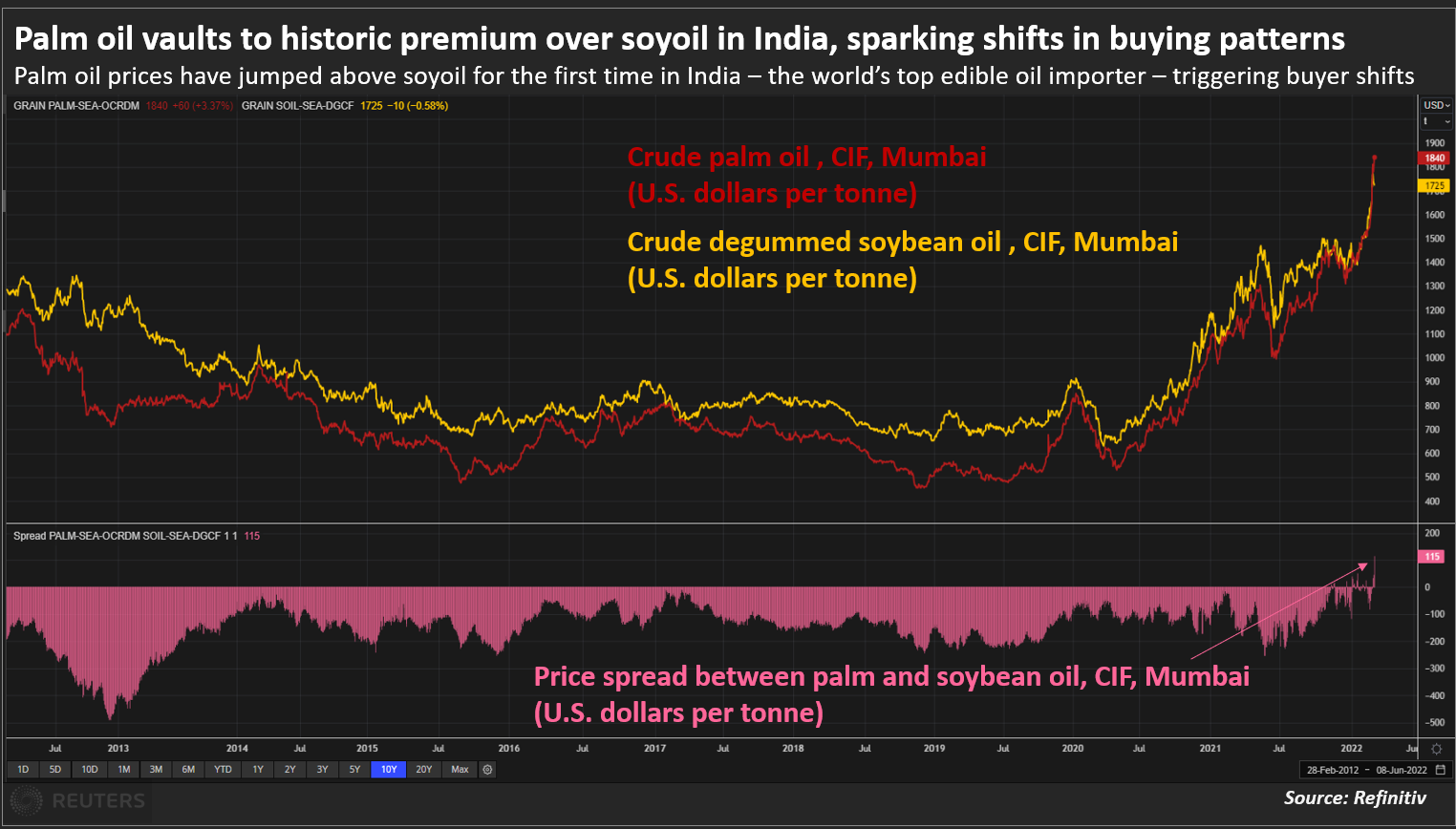
MUMBAI, March 1 (Reuters) – Palm oil has become the costliest among the four major edible oils for the first time as buyers rush to secure replacements for sunflower oil shipments from the top exporting Black Sea region that were disrupted by Russia’s invasion of Ukraine.Palm oil’s record premium over rival oils could squeeze price-sensitive Asian and African consumers already reeling from spiralling fuel and food costs, and force them to curtail consumption and shift to rival soyoil , dealers said.Crude palm oil (CPO) is being offered at about $1,925 a tonne, including cost, insurance and freight (CIF), in India for March shipments, compared with $1,865 for crude soybean oil.Register now for FREE unlimited access to Reuters.comRegisterCrude rapeseed oil was offered at around $1,900, while traders were not offering crude sunflower oil as ports are closed due to the Ukraine crisis.
Palm oil vaults to historic premium over soyoil in India, sparking shifts in buying patternsThe Black Sea accounts for 60% of world sunflower oil output and 76% of exports. Ports in Ukraine will remain closed until the invasion ends. read more “Asian and European refiners have raised palm oil purchases for near-month shipments to replace sunoil. This buying has lifted palm oil to irrational price level,” said a Mumbai-based dealer with a global trading firm.”They have the option of buying soyoil as well. But prompt soyoil shipments are limited and they take much longer to land in Asia compared to palm oil,” he said.Soybean production in Argentina, Brazil and Paraguay is expected to fall because of dry weather. Price-sensitive Asian buyers traditionally relied on palm oil because of low costs and quick shipping times, but now they are paying more than $50 per tonne premium over soyoil and sunoil, said a Kuala Lumpur-based edible oil dealer.Palm oil’s price premium is temporary, however, and could fade in the next few weeks as buyers shift to soyoil for April shipments, the dealer said.Most of the incremental demand for palm oil is fulfilled by Malaysia, as Indonesia has put restriction on the exports, said an Indian refiner. “Malaysian stocks are depleting fast because of the surge in demand. It is the biggest beneficiary of the current geopolitical situation,” he said.Register now for FREE unlimited access to Reuters.comRegisterReporting by Rajendra Jadhav
Editing by Shri NavaratnamOur Standards: The Thomson Reuters Trust Principles. .

Insurance costs of shipping through Black Sea soar
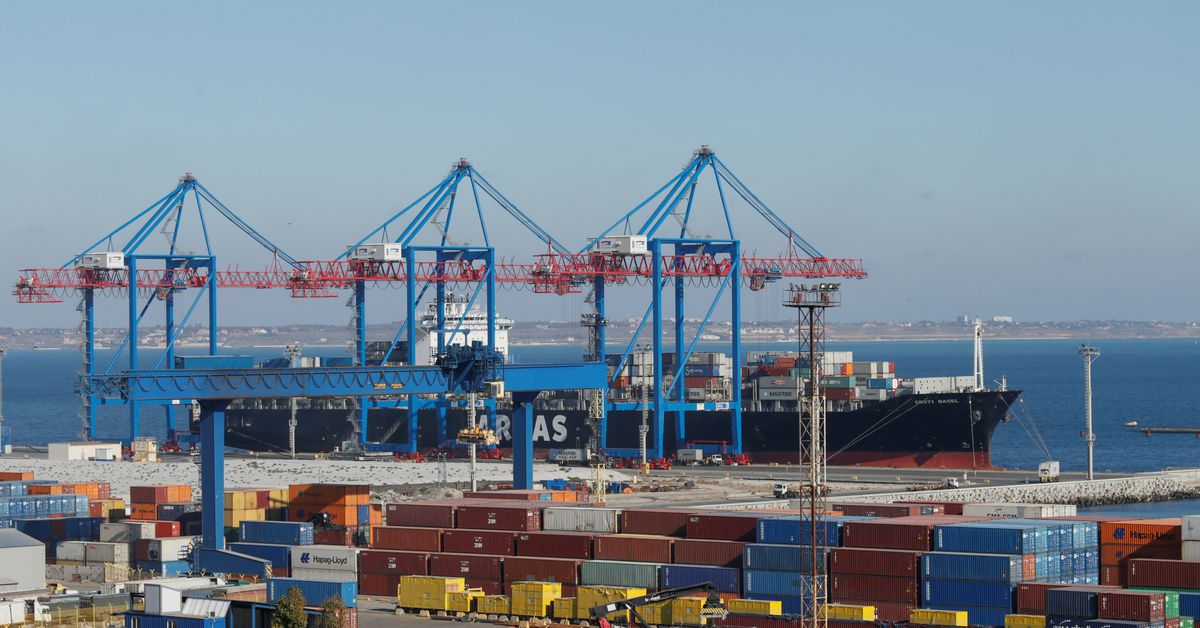
The Arkas Line’s Conti Basel container ship is docked in the Black sea port of Odessa, Ukraine, November 4, 2016. REUTERS/Valentyn OgirenkoRegister now for FREE unlimited access to Reuters.comRegisterLONDON, Feb 25 (Reuters) – Insurers have raised the cost of providing cover for merchant ships through the Black Sea, adding to soaring rates to transport goods through the region for vessels still willing to sail after Russia’s invasion of Ukraine.Ship owners pay annual war-risk insurance cover as well as an additional “breach” premium when entering high-risk areas. These separate premiums are calculated according to the value of the ship, or hull, for a seven-day period.Ship insurers have quoted the additional premium rate for seven days at anywhere between 1% to 2% and up to 5% of insurance costs, from an estimated 0.025% on Monday before Russia’s invasion began, according to indicative rates from marine insurance sources.Register now for FREE unlimited access to Reuters.comRegisterThis would mean additional costs of hundreds of thousands of dollars for a ship voyage depending on the destination.”Given the Russian offensive from land, sea and air, it would not be surprising if some insurers will be reluctant (to provide cover),” one insurance source said.A Moldovan-flagged chemical tanker was hit by a missile on Friday near Ukraine’s port of Odessa, seriously wounding two crew.On Thursday, a Turkish-owned ship was hit by a bomb off Odessa with no casualties and the ship sailed safely into Romanian waters.Ukraine has appealed to Turkey to block Russian warships from passing through the Dardanelles and Bosphorus straits which lead to the Black Sea, after Moscow on Thursday launched a full-blown assault on Ukraine. read more Russian forces landed at Ukraine’s Black and Azov Sea ports as part of the invasion.Ukraine’s military has suspended commercial shipping at its ports although some Russian Black Sea ports remain open, including Novorossiisk, traders said on Friday.”Due to the sea invasion potential and Crimea’s location in the Black Sea, freight destined for surrounding countries will likely see re-routings and longer transit to meet its final destination,” added Glenn Koepke with supply-chain tracking platform FourKites.Mark Nugent, with shipbroker Braemar ACM, citing satellite tracking data, said a number of dry bulk vessels in the Black Sea had reversed course and were sailing towards the Bosphorus to exit the region.Freight rates have jumped after shipping companies including the world’s top container lines MSC and Maersk and many oil tanker owners suspended sailings through the region.Average earnings for smaller aframax tankers trading in the Black Sea jumped to over $100,000 a day on Thursday from $8,000 a day on Monday, shipping sources said.Earlier this month, London’s marine insurance market added the Ukrainian and Russian waters around the Black Sea and Sea of Azov to its list of areas deemed high risk, which prompted some shipping companies to hold back on sending vessels into the area. read more Register now for FREE unlimited access to Reuters.comRegisterAdditional reporting by Michael Hogan in Hamburg and Carolyn Cohn in London; Editing by Nick MacfieOur Standards: The Thomson Reuters Trust Principles. .
Tight supplies lift Mideast, Russian crude grades to multi-year highs
- Cash Dubai’s premium breaches $4/bbl for first time – Platts
- ESPO premiums jump to $7/bbl, highest since Dec 2019
- Sokol premiums rise to highest since Dec 2019
SINGAPORE, Feb 16 (Reuters) – Middle East benchmark Dubai crude soared to a record this week while spot premiums for April-loading Russian oil jumped to their highest in more than two years in Asia, trade sources said on Wednesday as prices returned to pre-pandemic levels.The global supply-demand balance has tightened as the Organization of the Petroleum Exporting Countries and its allies are lagging behind commitments to increase output by 400,000 barrels per day each month. read more Demand, meantime, is robust as refiners globally are cranking up operations to reap higher margins on gasoline and diesel.Register now for FREE unlimited access to Reuters.comRegisterThe Russia-Ukraine crisis has also boosted Brent prices, pushing the benchmark’s premium to Dubai to its highest since 2013 this week.There was no immediate sign of the price spread weakening after Russia pulled back some of its forces from the border on Tuesday.The wide spread between the benchmarks is boosting Asia’s demand for Middle East and Russian grades priced off Dubai, leading spot premiums to hit multi-year highs this month.Cash Dubai hit a record high at Tuesday’s market close, breaching $4 a barrel premium over futures for the first time, oil pricing agency S&P Global Platts reported.The April cash Dubai versus same-month Dubai futures was assessed at a premium of $4.08 a barrel, Platts data showed.For Russian grades, spot premiums for ESPO Blend crude exported from the Far East port of Kozmino soared to their highest in more than two years after producer Surgutneftegaz sold three cargoes via a tender, trade sources said.The cargoes for late March to early April loading were sold at premiums of $7-$7.10 a barrel above Dubai quotes, they said, about $2 higher than last month.ESPO crude premiums were last seen at these levels in December 2019, Refinitiv data showed.Trading houses Mitsui and Petraco bought the cargoes, the sources said.Similarly, spot premiums for Russian Sokol crude loading in April jumped to their highest since January 2020 after India’s ONGC Videsh sold a cargo via a tender, they added.The cargo for April 19-25 loading was sold to Glencore at a premium of $7.80-$7.90 a barrel to Dubai quotes, the sources said.Register now for FREE unlimited access to Reuters.comRegisterReporting by Florence Tan in Singapore and Olga Yagova in Moscow; Editing by Tom Hogue, Shailesh Kuber & Simon Cameron-MooreOur Standards: The Thomson Reuters Trust Principles. .

Treasury Wine shares surge as ex-China growth begins to pay off
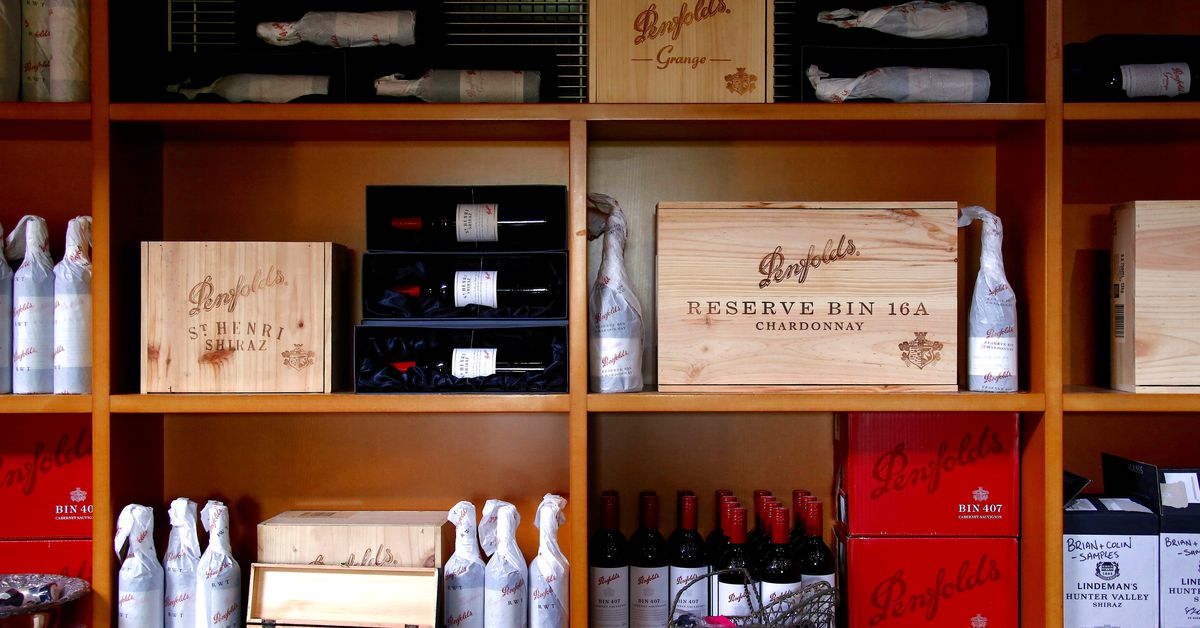
Bottles of Penfolds Grange wine and other varieties, made by Australian wine maker Penfolds and owned by Australia’s Treasury Wine Estates, sit on shelves for sale at a winery located in the Hunter Valley, north of Sydney, Australia, February 14, 2018. REUTERS/David GrayRegister now for FREE unlimited access to Reuters.comRegisterFeb 16 (Reuters) – Treasury Wine Estates (TWE.AX) said on Wednesday its operating earnings outside mainland China jumped 28%, underpinned by growth in its luxury and premium brands, sending shares of the world’s largest standalone winemaker nearly 12% higher.Treasury has had to re-direct supply to the United States, Europe and domestically after a diplomatic row between Canberra and Beijing effectively closed the lucrative Chinese market to Australian wine.The company said it recorded strong growth in its Americas and premium brands businesses, both of which reported a 19% rise in their earnings before interest, tax, SGARA and material items (EBITS).Register now for FREE unlimited access to Reuters.comRegister“Penfolds growth was particularly strong in Asian markets outside of Mainland China … increasing distribution in Asia, domestic markets, Europe and the United States was a key execution highlight,” the company said in a statement.Reported EBITS, excluding Australian COO wine sold in mainland China, rose to A$262.4 million ($187.7 million), narrowly missing market expectations of A$265 million while its total net profit slid 7.5% to A$109.1 million.The company said trading conditions for the remainder of fiscal 2022 were expected to remain broadly in line with the first half across its key markets and channels.”Despite FY22 potentially shaping up to be slightly softer than expectations, we see Treasury doing a commendable job building demand for its products in new markets,” Citi analysts said in a note.Treasury shares jumped as much as 11.8% to A$11.78 in early trading, while the broader market (.AXJO) rose 0.4%.The company said it plans to increase prices across select portfolio brands to partly mitigate the impact of elevated supply chain costs and logistics. The Melbourne-based firm retained its interim dividend of 15 Australian cents per share.($1 = 1.3986 Australian dollars)Register now for FREE unlimited access to Reuters.comRegisterReporting by Tejaswi Marthi and Savyata Mishra in Bengaluru; Editing by Aditya Soni and Sherry Jacob-PhillipsOur Standards: The Thomson Reuters Trust Principles. .